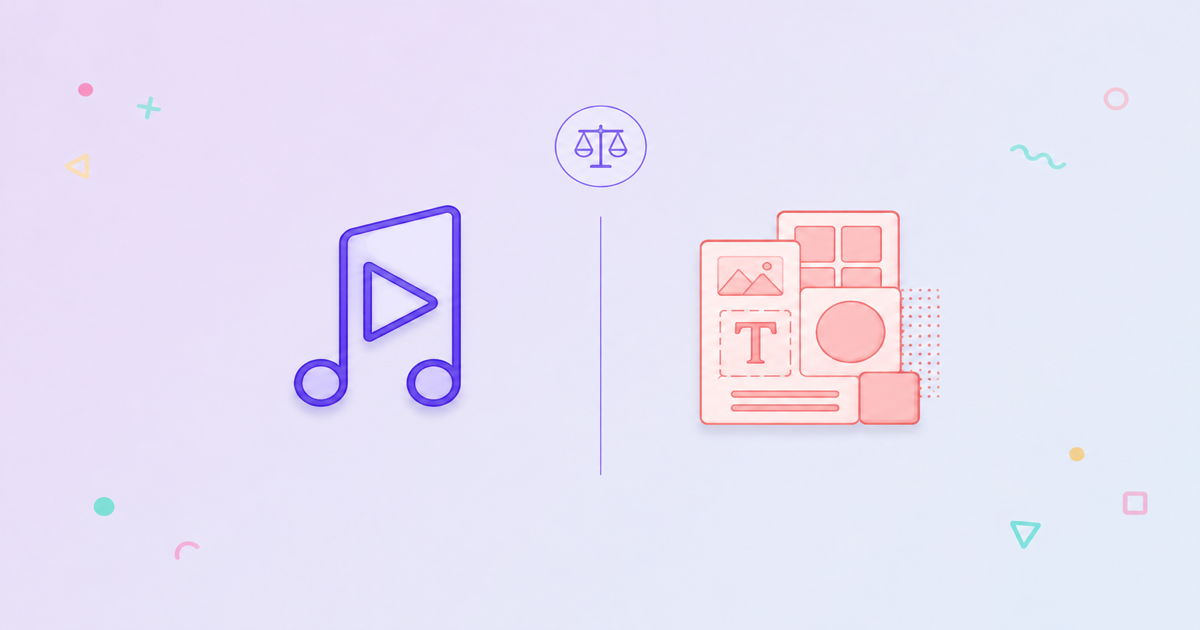
Melodex vs Canva Video for AI Music Videos
Two very different tools for non-editors. Where Canva fits, where Melodex wins for music video work, and how to choose in 2026.
Kevin Gabeci
If you are a musician who has never edited video and you are looking at tools, the two names that come up the most are Canva and Melodex. Both promise that someone with no editing background can ship a finished video. Both are usable in a browser. Melodex gives a one-time 100 GP welcome grant after email verification, while Canva has its own free product tier. From the outside they can look like substitutes.
They are not. Canva and Melodex are doing different jobs, and once you see the difference the choice is mostly obvious. This piece walks through what each tool is built for, how a music video workflow actually feels on each, where the output lands, and how to pick. I have used both. I will be fair to both.
What each tool is built for
Canva started as a graphic design tool for non-designers. Posters, social posts, presentations, photo edits, brand kits. Over the last few years they have stretched into video, but the bones of the product are still graphic design. When you open Canva and click “video,” you get a timeline editor with templates, stock clips, royalty-free music, and a generative AI feature that can produce short text-to-video clips. The mental model is “PowerPoint for the social media era.”
Melodex started in the other direction. The product was built around one specific job: take an audio idea and turn it into a finished AI music video. There is no template gallery for birthday cards. There is no logo maker. The audio layer (upload, voice-sample generation, prompt-to-song), the visual layer (scene-by-scene generation tied to the song’s structure), and the sync layer (cuts that hit on the beat and on the lyrics) are wired together because that is the only thing the tool is for.
Both teams have made their tradeoffs honestly. Canva is broad and shallow. Melodex is narrow and deep. The question is which of those shapes fits your job.
How a music video workflow feels on each
Let’s walk through the same project on both tools and see where the friction shows up.
You have a 3 minute song you wrote. You want a music video for YouTube and a 30 second vertical cut for Shorts.
On Canva. You open the video editor. You upload your audio to the timeline. You start adding clips. The clips come from three places: stock library footage that does not match your song, generic AI clips from short text prompts that do not respond to the audio, or images you upload yourself. You manually drag clip boundaries to land on beats by ear. You add lyric captions one verse at a time using the text tool. By the time you have something that resembles a music video, you have spent more time in the timeline than the song lasts. The output is a timeline of clips that play during a song. It does not feel like the visuals were made for the song, because they weren’t.
On Melodex. You upload the audio. You write a one sentence world description and per-scene prompts that match the structure of the track (verse, chorus, bridge, final chorus). The platform generates the scenes against your prompts, syncs them to the song’s structure, and stitches the result. You watch the draft, regenerate the scenes that drift, and ship. The output is a video where the visuals were generated to fit the audio, not assembled around it. For the deeper version of this end to end, see how to make an AI music video from scratch.
The vertical cut shows the gap clearly. On Canva you rebuild the project in a 9:16 canvas and recut. On Melodex you toggle aspect ratio and re-render from the same scene prompts, because the framing was planned with both ratios in mind.
Output quality
Quality is genre dependent, and I want to be fair here because Canva does some things well.
For static branded content (an album announcement card, a tour date graphic, a quote post), Canva’s output is excellent and Melodex doesn’t try to compete. Canva’s typography, brand kit support, and template library are real advantages.
For an AI music video, Melodex is the more focused workflow because its generated scene images, project-wide style direction, audio, captions, and rendering live in one project. Canva’s breadth is the advantage when you want stock footage, templates, brand assets, and manual timeline control. The stronger result depends on whether you need focused generation or broad editing control.
Neither tool is going to embarrass you. Canva will get you something that looks polished in the way a corporate explainer looks polished. Melodex will get you something that looks like a music video. Pick the right kind of polished for the job.
Pricing in 2026
Melodex starts with 100 one-time GP after email verification. Paid plans are Starter at $12.99 per month, Creator at $29, and Pro at $69, with discounted yearly billing and a monthly GP allowance. Generation and rendering spend GP, and optional one-time GP packs can supplement a plan when those packs are available. Canva’s pricing and AI allowances change independently, so check its current pricing page before buying.
If you are going to make one music video and many social graphics, Canva’s breadth may be the better value. If the music video itself is the product, Melodex’s narrower workflow removes more cross-tool work. If you need both jobs, the tools can complement each other.
For a deeper look at how AI video generators stack up beyond just these two, see the AI video generation tools comparison.
Comparison table
| Question | Canva Video | Melodex |
|---|---|---|
| Built for music videos? | No, general purpose | Yes, specifically |
| Audio first workflow? | No, you assemble around audio | Yes, audio drives generation |
| Lyric and beat sync? | Manual only | Automatic with manual fine tuning |
| Scene consistency across a video? | Not modeled | Modeled via global style prompt |
| Brand kits and graphics? | Strong | Not the focus |
| Templates and stock? | Huge library | Not the model |
| Vertical re-render from same project? | Manual rebuild | Toggle and re-render |
| Sweet spot | Posters, social posts, presentations | AI music video end to end |
So which one do you pick
Pick Canva if your real job this month is brand assets and short social content with a music video as a side quest. Pick Melodex if the music video itself is the project and the brand assets are the side quest.
A lot of working indie musicians end up using both. Canva for the album art layout, the announcement post, the tour date graphic, the YouTube end card. Melodex for the actual music video, the Shorts cut, the lyric video. The tools complement each other well because they are not trying to do the same job. The mistake is using Canva for music video work because you already have the subscription, then wondering why the result looks like a slideshow with audio. That is not a Canva failure. That is a wrong-tool failure.
If the music video is the thing you actually need to ship, start a project in Melodex, upload your track, and see how a tool built for the job feels different from a tool stretched into the job.
Frequently asked questions
- Can Canva make a real music video?
- Yes, in the same way a Swiss Army knife can carve a turkey. Canva can stitch clips, add captions, and drop in royalty-free music. What it cannot do well is generate the visuals from a song, sync cuts to lyrics, or render scenes that feel like they belong to one world. For social posts and ad cuts, Canva is fine. For a music video where the visuals respond to the audio, it gets thin fast.
- Does Melodex do everything Canva does?
- No, and that is on purpose. Melodex is not a brand kit, a presentation tool, or a photo editor. It does one thing: AI music video from audio plus prompts to a finished file. If you need a logo lockup or a YouTube thumbnail, Canva is the better pick. If you need the actual video, Melodex is built for the job.
- Which one is cheaper for a single music video?
- Per project, Canva Pro is cheaper if you already pay for it and you only need basic templates. Melodex charges based on render credits, so a 3 minute music video sits in the same neighborhood as a couple of months of Canva Pro. The honest answer is that they are not really competing on price because they are not really doing the same job.
- Can I use Canva for the thumbnail and Melodex for the video?
- Yes, and that is what a lot of indie musicians actually do. Render the video in Melodex, export a still frame, drop it into Canva for the YouTube thumbnail with text and brand elements. The two tools are complementary in a real workflow, not replacements for each other.
- Does Canva have any AI music video features?
- Canva has a generic AI video generator that produces short clips from text prompts, plus basic stock library access. It is not designed around audio or music structure, so the clips do not respond to your track. You can manually align cuts, but that defeats the point of an AI tool.
- Which tool gives better visual quality?
- Melodex pulls from frame generators tuned for music video aesthetics and produces cinematic outputs by default. Canva's AI video output is closer to social-media-grade stock with good typography on top. Both can look great in their own lane. Pick by lane, not by raw quality.
Keep reading
How to Control Song Structure in AI Music
Stop AI music from defaulting to the same generic arrangement. Use section tags, lyric labels, and prompt phrasing to force real intros, choruses, bridges, and dynamics.

How to Produce an AI Album in a Weekend
A batch workflow for building a cohesive AI album in two days. Concept, tracklist, batched generation, comping, mixing, and mastering the whole thing as one set.