State by State Voice Cloning Laws (2026 Update)
How US voice cloning law has changed by 2026, state by state. Tennessee's ELVIS Act, California, New York, and the rest.
Kevin Gabeci
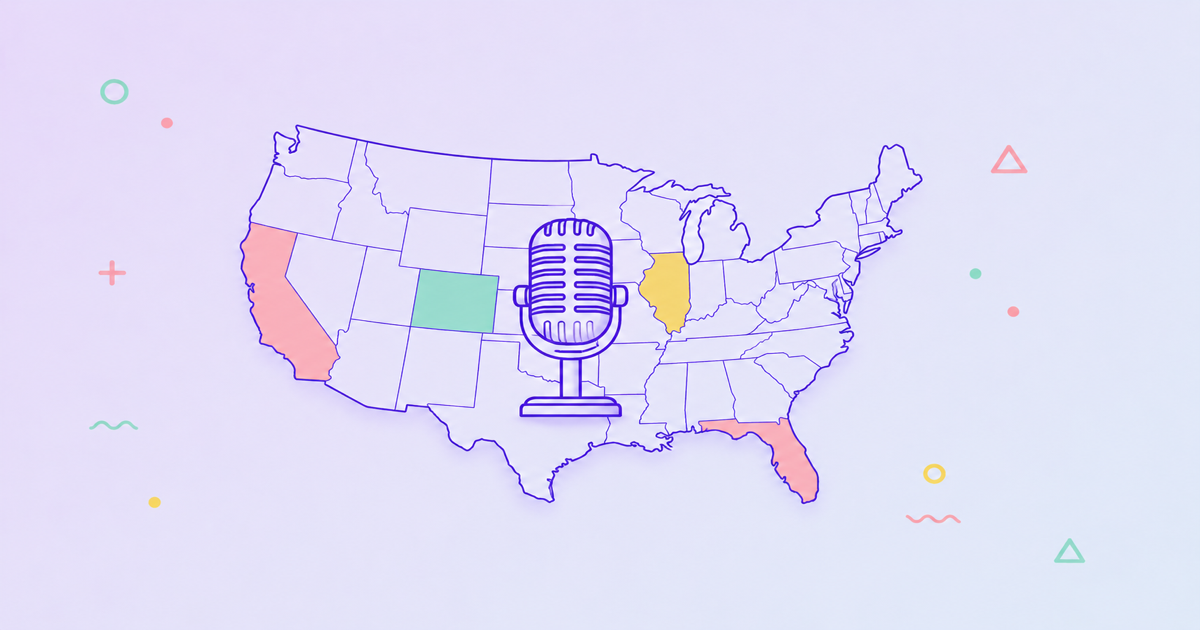
US voice cloning law in 2026 is a patchwork. Congress has talked about a federal statute for three years and not passed one. In the absence of that floor, individual states have moved at very different speeds, and the result is that the same voice clone can be perfectly legal in one state and criminal in another.
This piece walks through where the line actually sits in April 2026, state by state. The format is practical: what the law says, what it actually means for a creator, and where the edges are.
This is not legal advice. The law moves quarter by quarter. Where I cite a specific statute I will link the primary source. Where I describe a norm or a likely outcome, I will say so.
The federal floor
Before the state map, the federal layer.
There is no single federal voice cloning statute as of April 2026. The two federal handles that do exist:
The FTC Impersonation Rule. Finalized in 2024 and now in active enforcement, the Federal Trade Commission’s rule on impersonation of individuals in commerce makes it unlawful to impersonate a real person or entity in trade or commerce, full stop. Voice cloning a real person’s voice to sell something is FTC-actionable. The text is at ftc.gov.
The NO FAKES Act. Reintroduced in Congress most recently in 2025, this bill would create a federal right of publicity covering voice and likeness, with safe harbors for platforms that take down infringing content. As of April 2026 it has bipartisan sponsors and committee movement, but no passage. Watch this space.
So at the federal level, you have a commercial impersonation rule with teeth and a hopeful but unpassed publicity bill. The action is at the state level.
Tennessee (ELVIS Act)
The Ensuring Likeness Voice and Image Security Act, signed into law in March 2024, is the strongest voice cloning statute in the country.
What it does:
- Makes it unlawful to publish, perform, distribute, or otherwise make available a voice that is “indistinguishable from” a real person’s voice without consent.
- Covers both living and deceased individuals, with rights running for fifty years post-mortem and renewable beyond that.
- Allows civil suits with statutory damages.
- Treats violations as a Class A misdemeanor for individual offenders.
- Crucially, it covers the voice itself, not just the commercial use of the voice. You can be sued for an uncompensated, non-commercial clone.
Why it matters even if you are not in Tennessee: a lot of music industry plaintiffs file there because Nashville is the country music capital, the bar is friendly, and the statute is broad. Many of the lawsuits you will see in 2026 against AI vocal clones are Tennessee actions.
Primary source: the Tennessee statute on the state’s website.
California
California does not have a voice-specific statute as broad as Tennessee’s, but it has two strong handles.
Civil Code section 3344. California’s long-standing right of publicity statute makes it actionable to use a person’s name, voice, signature, photograph, or likeness for commercial purposes without consent. Voice has been part of this statute since 1985, and the California courts have applied it to imitations as well as recordings (see Midler v Ford, the seminal case).
AB 2655 and AB 2839. California’s 2024 election deepfake laws added disclosure and takedown obligations for synthetic media depicting candidates and election officials. These are narrower than Tennessee’s statute but they are active law.
A new omnibus bill targeting commercial AI voice cloning was introduced in 2025 and was still in committee at the time of writing. If it passes, California will move closer to the Tennessee model. Until then, California claims live under section 3344 and the Midler line of cases.
New York
New York has Civil Rights Law sections 50 and 51, which protect against unauthorized commercial use of a person’s name, portrait, picture, or voice. The protection is real but narrower than California’s because:
- It applies to commercial uses only, not to all uses of the voice.
- New York’s post-mortem right of publicity, added in 2020 (Section 50-f), covers the voices and images of deceased performers and is one of the more useful tools for estates of dead artists.
Practical effect: cloning a living New Yorker’s voice for a commercial product is actionable. Cloning their voice for a parody or non-commercial work is much harder to challenge. The NY courts will look at how commercial the use is.
Illinois
Illinois has the Right of Publicity Act and, separately, the Biometric Information Privacy Act (BIPA). BIPA is the wildcard that makes Illinois interesting.
BIPA treats biometric identifiers, including voiceprints, as protected data that may not be collected or shared without informed written consent. A voice cloning service that fingerprints your voice without consent has a BIPA exposure even if no clone is ever shared publicly. BIPA has produced billion-dollar settlements in the past for facial recognition cases. Voice is on the same statute.
For creators, the practical takeaway is: if you are operating a tool or a service that captures voice samples from Illinois residents, BIPA applies to you. If you are an individual cloning your own voice, BIPA mostly does not.
A state by state snapshot
The table below summarises where each state sat as of April 2026. Strength is my own qualitative read of how easy it is to bring a successful voice-cloning claim there.
| State | Specific statute | Right of publicity | Strength |
|---|---|---|---|
| Tennessee | ELVIS Act (2024) | Strong, post-mortem 50 yrs | Highest |
| California | Election deepfake laws | Civil Code 3344 + Midler line | High |
| New York | None voice-specific | Civil Rights 50, 51, 50-f | Medium-high |
| Illinois | BIPA (covers voiceprints) | Right of Publicity Act | Medium-high |
| Texas | None voice-specific | Property Code Chapter 26 (post-mortem) | Medium |
| Florida | None voice-specific | Common law and statute | Medium |
| Washington | None voice-specific | RCW 63.60 | Medium |
| Indiana | None voice-specific | Strong common law | Medium |
| Massachusetts | None voice-specific | Common law | Low-medium |
| Most other states | None | Common law right of publicity | Variable, generally low |
A few states have introduced bills in 2025 that may move them up this table by the end of 2026: Georgia, Michigan, Minnesota, and New Jersey are the ones to watch.
For creators trying to think through a real release, the question is rarely “is it legal in my state.” The question is “is it legal in every state where someone might sue me.” That second question pushes the bar to roughly the Tennessee level for most distributed work.
States with no specific laws
Most states still have no voice-specific statute in 2026. They cover voice cloning under common law right of publicity, defamation, false light, and (for commercial uses) state unfair-trade-practices laws.
What this means in practice:
- The bar to bring a claim is higher.
- The remedies are typically smaller.
- Defendants have more room to argue the use was not commercial, was transformative, or was satire.
- Cases are slower and more uncertain.
You cannot use “no specific law in my state” as a shield. The plaintiff usually picks the venue. If they live in Tennessee and you streamed your clone there, the Tennessee bar is the one that applies.
The bottom-line creator rules
Skip the legal weeds and these four rules cover ninety-plus percent of what a creator actually needs to think about.
Clone yourself freely. Your voice, your consent, your call. No statute in any state restricts this.
Get explicit, documented consent for anyone else. A signed agreement, a clear scope, a revocability clause for future work. This is covered in more depth in the AI voice cloning ethics guide.
Assume the strictest state’s law applies. If you are publishing nationally, assume Tennessee’s bar. If you are publishing globally, assume the EU AI Act’s disclosure floor on top. The cost of compliance with the strictest rule is small. The cost of being wrong is not.
Disclose synthetic origin. Even when not legally required, disclosure is the cheapest reputational insurance you can buy. Platforms reward it. Audiences reward it. Lawsuits avoid it.
For tool-by-tool tradeoffs on voice cloning vendors, see ElevenLabs vs Resemble. For the broader fair-use map covering AI music videos and likeness, see fair use and AI music video.
Closing
US voice cloning law in 2026 is patchier than it should be, but the trend line is unambiguous: stricter, not looser, almost everywhere. The states that have moved (Tennessee most aggressively) are the template that other states are studying. Federal action is likely but not yet here.
If you are a creator working with voice cloning today, treat Tennessee as the floor. Get consent. Document it. Disclose synthetic origin where the platform asks. Do those four things and the patchwork is a curiosity, not a hazard.
This was not legal advice. If you are about to release anything that involves a real person’s voice, talk to a lawyer in your jurisdiction first. And if you want to work with synthetic voices that ship with the rights story handled, Melodex defaults to voices you own or generate, never a real person you do not.
Frequently asked questions
- Is there a federal voice cloning law in 2026?
- There is no single federal voice cloning statute. The FTC Impersonation Rule covers commercial impersonation, and the NO FAKES Act has been reintroduced in Congress but has not passed as of April 2026.
- Which state has the strongest voice cloning law?
- Tennessee. The ELVIS Act passed in 2024 makes unauthorized voice cloning a civil and criminal offense with statutory damages, and it covers the voice itself rather than only its commercial use.
- What about California?
- California relies on its long-standing right of publicity statute plus newer disclosure rules for political deepfakes. There is no voice-specific statute as broad as Tennessee's, but enforcement is active.
- Does the law apply if I'm in one state and the cloned person is in another?
- Often yes. Right of publicity claims can usually be filed where the affected person resides, where the harm occurred, or where the platform operates. Treat this as a multi-state risk.
- What if the person I cloned is dead?
- Most US states recognise post-mortem rights of publicity for a set term, ranging from zero to seventy-five years. Tennessee's term is the longest. Do not assume a deceased artist's voice is fair game.
- Does voice cloning my own voice need any of this?
- No. You consent to your own voice by definition. Document the consent on a written record anyway, especially if you are uploading the clone to a platform that asks.
- Is this legal advice?
- No. The law is moving quickly and varies by state. This is a creator-level overview. Consult a lawyer in your jurisdiction before relying on it.
Keep reading
How to Control Song Structure in AI Music
Stop AI music from defaulting to the same generic arrangement. Use section tags, lyric labels, and prompt phrasing to force real intros, choruses, bridges, and dynamics.

How to Produce an AI Album in a Weekend
A batch workflow for building a cohesive AI album in two days. Concept, tracklist, batched generation, comping, mixing, and mastering the whole thing as one set.